A Scoring Rubric for Your Next Model Bake-Off
 Creative Studio Editorial
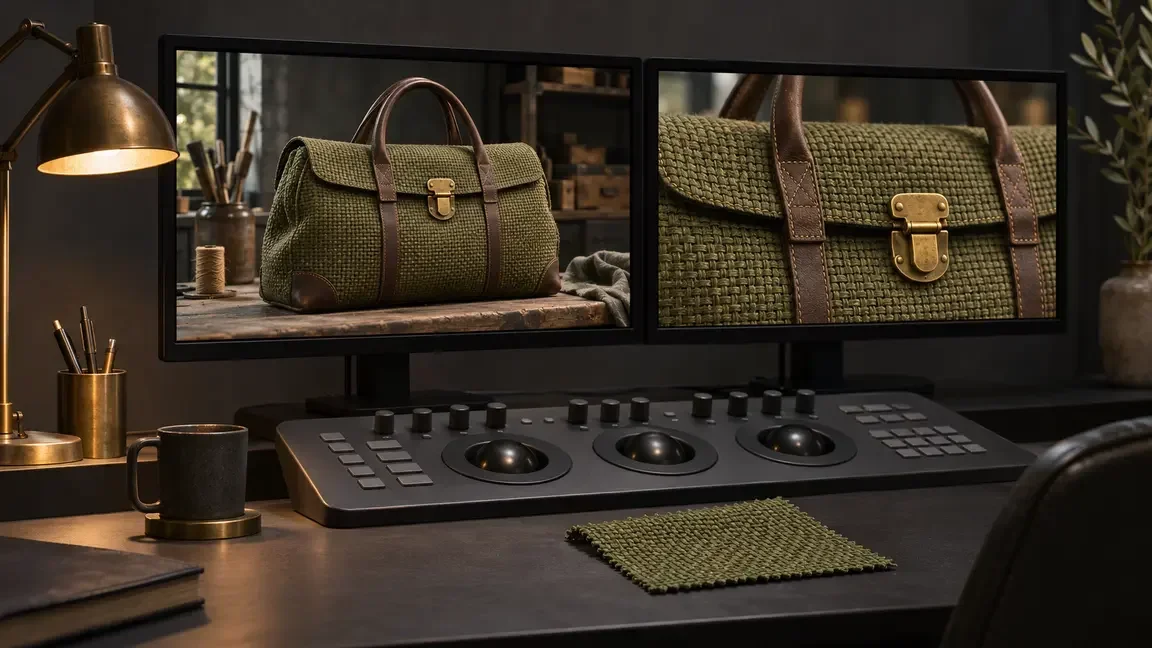
A production team has a reference photo of an olive travel bag. The shot brief asks for a hand closing its brass latch while the bag stays recognizable. Two candidate video models are available. One editor cares most about the cut on the closing motion. The client cares most about the bag's appearance. A useful review has room for both judgments and shows how they contributed to the decision.
Agree on the rubric before the team sees the takes. That keeps the choices about what matters separate from anyone's reaction to a particularly striking frame.
Write the pass conditions first
Some requirements are essential. In the travel bag example, the visible latch must stay on the same side of the bag, the hand must close it successfully, and the finished sequence needs the agreed crop. A take that misses one of those conditions gets a short reason in the review log. Handle that decision before calculating a score.
Set the allowance for each candidate. Use the same approved references, output target, and number of attempts where those inputs are supported. If a candidate requires a different way of providing a reference, record what you used. If the requirement is unavailable for that candidate, mark it as out of scope for the brief. Give finalists the same extra revision allowance if a second round is needed.
Create a scale reviewers can apply
Use a simple scale from zero to four. Zero means the criterion is absent, one means it needs a new take, two means it needs a meaningful repair, three means it needs a minor adjustment, and four means it is ready for the edit. Write the observation beside the number. “Trim the first few frames before the hand enters” gives the editor something concrete to check.
Choose weights for the actual shot. This sample rubric places most of the weight on what a viewer needs to recognize and follow.
| Criterion | Weight | What to check |
|---|---|---|
| Identity | 35 | The fabric, shape, and latch read as the approved bag. |
| Action | 30 | The hand closes the latch clearly at the intended pace. |
| Edit flexibility | 20 | The usable section has room for the cuts on both ends. |
| Frame and light | 15 | The crop works and lighting fits the neighboring shots. |
Multiply each rating by its weight and divide it by four. In a hypothetical review, ratings of four, three, three, and two yield 35, 22.5, 15, and 7.5 points, for a total of 80 out of 100. The numbers describe a single run against this brief. A different assignment may place its weight elsewhere.
Check the spread as well as the best take
Give candidates neutral clip names so reviewers can work from the footage before discussing which model made it. Use the same viewing crop and speed. Record how many takes cleared the requirements, then note the score and any repair needed for the strongest one. Keep preparation time, generation time, and actual costs visible beside the scores so the producer can assess them.
If reviewers disagree by more than a point on a criterion, watch the relevant moment together. A delay in the latch action might be easy for one editor to trim and hard for another if the cut needs the full reach. Resolve the applied interpretation and keep any remaining uncertainty in the notes.
Record the scope of the decision
Save the reference, rubric, settings, and selected clip with a short decision. A producer might choose the clip with the cleanest latch and reserve a second candidate for a later test with people in motion. When the brief changes, review the weights and pass conditions before running the test again. The rubric gives the team a repeatable way to make a decision for the next specific shot.